
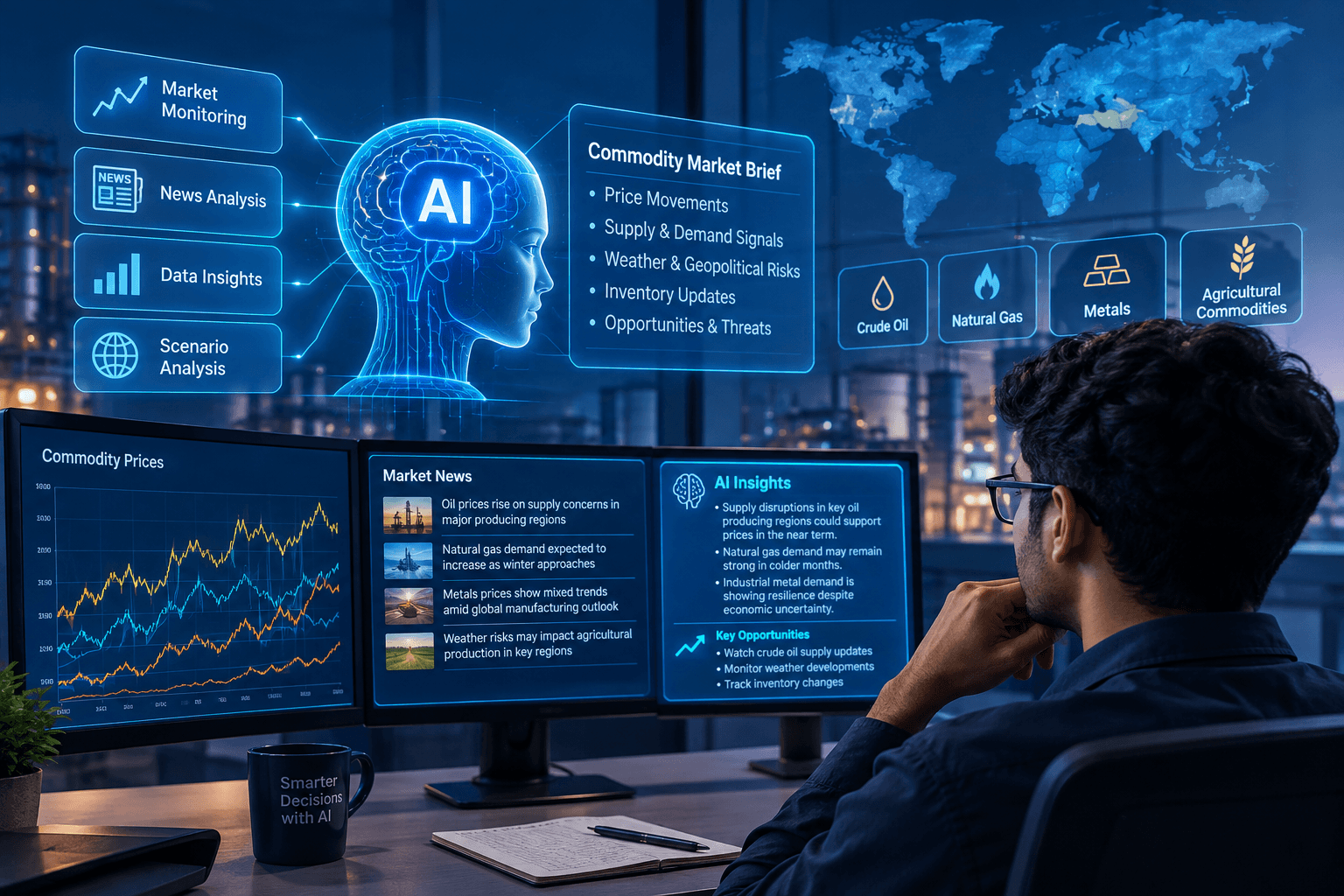
Commodity trading is a profession built around information. Traders constantly evaluate prices, supply and demand, weather, inventories, shipping activity, production updates, geopolitical events, financial markets, and breaking news. The challenge is not simply finding information. It is deciding what matters, why it matters, and what to do next.
This is where AI agents are becoming increasingly relevant. Instead of functioning only as chatbots that answer questions, AI agents can be designed to monitor information, use software tools, analyze multiple signals, and complete parts of a business workflow.
For students and freshers in India, this development is worth studying even if you have no intention of becoming a commodity trader. It shows how AI is moving from content generation toward real-world decision support and workflow automation. The same skills used to build these systems can be useful across AI engineering, data science, software development, fintech, analytics, and AI product roles.
What Does the Commodity Trading Front Office Mean?
The front office generally refers to the part of a financial or trading organization that is directly involved in market activity, revenue generation, and business decisions.
In commodity trading, front-office professionals can include traders, market analysts, portfolio managers, and sales and trading teams. They may work with commodities such as crude oil, natural gas, electricity, metals, agricultural products, and related financial instruments.
A commodity trader does much more than watch a price chart. Consider an oil trader trying to understand whether a recent price movement is likely to continue. The trader may need to examine:
- Production and supply levels
- Inventory and storage information
- Demand expectations
- Refinery activity
- Shipping and transportation conditions
- Weather developments
- Government or regulatory announcements
- Geopolitical events
- Currency and broader market movements
These information sources can be different in format, speed, reliability, and relevance. A trader must bring them together and form a view.
That makes commodity trading an attractive environment for AI assistance because information processing is a major part of the workflow.
What Is an AI Agent?
An AI agent is a software system that can work toward a defined objective by combining an AI model with data, tools, instructions, and actions.
A traditional chatbot might work like this:
Trader: “Summarize today's oil market news.”
AI: “Here is a summary of today's news.”
An agentic workflow can be much broader:
Monitor approved market sources → identify important developments → retrieve relevant information → analyze the event → compare supporting signals → prepare a briefing → notify the trader.
The key difference is workflow execution.
An AI agent can potentially interact with APIs, databases, search systems, analytics tools, internal applications, and other software. It can perform multiple connected steps instead of answering one isolated question.
This does not mean an AI agent should automatically place trades. Financial decisions can involve significant risk, and organizations need permissions, controls, testing, monitoring, and human oversight. In many practical applications, the agent's role is to research, monitor, summarize, analyze, and support decisions while the human remains responsible for judgment.
Understanding this distinction is important for students. The goal of agentic AI is not simply to build a more impressive chatbot. It is to build software that can participate in a useful business process.
How AI Agents Can Help Commodity Traders
AI agents can potentially improve several parts of the trading workflow.
Continuous Market Monitoring
Markets can change quickly, and traders may need to monitor many information sources simultaneously. An AI agent can continuously monitor approved sources and flag developments that match predefined areas of interest.
For example, an agent could identify:
- Unusual commodity price movements
- New supply disruptions
- Changes in inventory information
- Production announcements
- Significant weather developments
- Shipping or logistics disruptions
- Relevant regulatory developments
- Major geopolitical events
The purpose is not to overwhelm the trader with more alerts. A well-designed system should reduce information overload by ranking and organizing what deserves attention.
News and Research Analysis
A trader may spend significant time reading reports and news from multiple sources. An AI agent can help collect relevant information and organize it around a specific commodity, region, or market question.
Instead of producing a simple list of headlines, a useful system can structure information around four questions:
- What happened?
- Why could it matter?
- What evidence supports that interpretation?
- What factors could make the interpretation wrong?
This approach is much more valuable than asking AI to generate a generic market summary.
Connecting Data Sources
Commodity markets contain both structured and unstructured data. Structured data can include prices, volumes, inventory figures, and other numerical observations. Unstructured information can include news articles, reports, announcements, and research documents.
An agent can potentially connect these different types of information.
For example, if a commodity suddenly moves in price, an agent could retrieve relevant market information, search approved news sources, identify recent events, compare the information, and prepare a research summary for the trader.
The benefit is not that the AI automatically knows the reason for the movement. The benefit is that it can shorten the investigation process.
Scenario Analysis
Trading decisions often involve several possible outcomes rather than one certain prediction.
An AI agent can help traders structure scenarios such as:
- What could happen if supply decreases?
- What could happen if demand weakens?
- Which indicators would support the scenario?
- Which assumptions are being made?
- What new information would invalidate the current view?
This helps turn an unstructured research task into a repeatable analytical workflow.
Why AI Agents Are Different From Traditional Automation
Traditional automation usually works through explicit rules.
For example:
If price crosses a defined threshold → send an alert.
This is useful when the conditions are predictable. But many market research tasks are more open-ended.
An AI-assisted workflow could look like:
Detect unusual movement → investigate possible causes → collect relevant information → compare evidence → summarize findings → identify risks and unanswered questions.
The ability to work through a sequence of related tasks is one reason AI agents are attracting attention.
But greater flexibility also creates new risks. AI systems can misunderstand information, use unreliable sources, make incorrect inferences, or produce confident-sounding answers without enough evidence.
For financial applications, responsible implementation therefore requires:
- Reliable data sources
- Clear permissions
- Human review
- Monitoring and logging
- Evaluation of agent outputs
- Error handling
- Security controls
- Clear separation between analysis and execution
A useful principle is:
The more consequential the action, the stronger the human oversight and system controls should be.
This is also an important lesson for students building AI projects. A good project should explain not only what the AI can do, but also where it can fail.
What a Future AI-Assisted Trading Workflow Could Look Like
Imagine a commodity trader beginning the day with an AI-generated market briefing.
Instead of manually opening many different sources, the trader could receive a structured dashboard containing:
- Important overnight market developments
- Commodity-specific news
- Significant price or volume movements
- Relevant supply and demand signals
- Weather or logistics developments
- Changes that could affect existing positions
- Events requiring further investigation
- Conflicting evidence and potential risks
The trader could then ask follow-up questions in natural language.
“Why did the system classify this event as significant?”
“What evidence supports this conclusion?”
“What information could challenge this analysis?”
“Compare this situation with similar historical conditions.”
This creates a human-AI collaboration loop. The agent handles repetitive information gathering and analysis, while the trader applies experience, judgment, risk awareness, and business context.
Over time, organizations may allow agents to perform more narrow actions within clearly defined boundaries. These could include generating reports, updating dashboards, creating alerts, preparing research notes, or performing other approved tasks.
More sensitive actions can remain behind human approval.
What Students and Freshers Should Learn From This Trend
You do not need to become a commodity trader to benefit from understanding agentic AI. The technology creates a useful blueprint for building AI applications in many industries.
If you are an Indian student or fresher, focus on developing a combination of technical ability and business understanding.
Learn AI and LLM Fundamentals
Understand how modern AI applications use large language models, prompting, structured outputs, retrieval, tool calling, and evaluation.
Do not focus only on writing clever prompts. Learn how models fit into complete software systems.
Build Strong Python Skills
Python is useful for AI applications, data processing, APIs, automation, and analytics. You should be able to work with real data, call APIs, handle errors, and build a small end-to-end application.
Learn Data and APIs
An AI agent is only as useful as the information it can access.
Build knowledge of:
- SQL and databases
- REST APIs
- JSON
- Data cleaning
- Data validation
- Basic data pipelines
- Cloud fundamentals
Understand Agent Architecture
Study concepts such as:
- Tool calling
- Retrieval-augmented generation
- Agent memory and state
- Workflow orchestration
- Human-in-the-loop systems
- Evaluation and monitoring
- Access control
If you want a structured way to develop these skills, explore relevant courses instead of learning disconnected topics without a project goal.
Build a Practical AI Agent Project
For students, one of the best ways to understand this technology is to build a small project around a real workflow.
A strong portfolio idea is a Commodity Market Research Agent.
The application could allow a user to select a commodity and then:
- Retrieve permitted market information
- Collect relevant news
- Categorize important developments
- Summarize market events
- Identify possible supply and demand factors
- Produce a structured market briefing
- Display supporting sources
- Separate facts from AI-generated interpretation
Do not market the project as a system that can reliably predict commodity prices. Instead, position it as a research and decision-support application.
Your project documentation should explain:
- The architecture
- Data sources
- Agent workflow
- Tools used
- Evaluation approach
- Known limitations
- Human-review requirements
- Security considerations
This demonstrates that you understand how AI connects to a real business problem rather than simply creating a chatbot interface.
You can use a career roadmap to organize the skills you need and explore relevant opportunities through the jobs board.
Career Opportunities Around AI and Trading Technology
The growth of AI agents can create opportunities across several technical and business roles.
AI Engineer
AI engineers build applications that connect language models with data, tools, APIs, and business workflows.
Machine Learning Engineer
Machine learning engineers develop models and intelligent systems that support data-driven applications.
Data Engineer
Data engineers build pipelines and infrastructure that allow AI applications to access reliable information.
Data Analyst
Data analysts turn structured data into insights that support business decisions.
AI Product Roles
AI product professionals identify useful business workflows and translate them into practical AI-enabled products.
FinTech and Financial Technology Roles
Financial technology teams need people who understand both technology and financial workflows. This combination can be valuable when building systems for research, risk, analytics, operations, and trading support.
For freshers, the most important lesson is to show evidence of practical ability. Saying “I know AI” is not enough. A recruiter should be able to see what you built, what problem it solves, which technologies you used, and how you evaluated the result.
Before applying, review whether your projects and skills are clearly communicated on your resume. You can use AI resume review to identify areas that need improvement.
The Bigger Lesson About AI Agents
Commodity trading is one example of a much broader transformation in professional software.
AI is moving from systems that primarily generate content toward systems that can participate in multi-step workflows.
Most professional work is not a single question. It usually involves a sequence:
Understand the objective → gather information → analyze it → make a decision → take action → monitor the result.
AI agents are being designed to participate in more parts of this sequence.
For students, that means AI literacy should go beyond knowing how to use a chatbot. A stronger career profile combines AI, programming, data, problem solving, communication, and domain knowledge.
You should also develop the habit of questioning AI-generated outputs. Ask where the information came from, whether the source is reliable, what assumptions were made, and what could be wrong.
This critical-thinking ability will become increasingly important as AI systems become more integrated into professional workflows.
What You Should Do Next
AI agents moving into commodity traders' front office is ultimately about using intelligent software to process information faster and support high-value decisions.
For students and freshers, the right response is not to chase every new AI tool. Instead, build durable skills: Python, AI fundamentals, data, APIs, agent workflows, problem solving, and communication.
Start with one real problem. Build an AI agent that solves a clearly defined research or analysis workflow. Document the architecture, test its limitations, explain where human review is needed, and present the project clearly on your resume.
Continue learning through practical resources and the Ucanly blog, while using structured learning to deepen the skills that matter for your target role.
The goal is simple: do not just learn AI tools. Learn how to use AI to solve real professional problems.