Most placement processes for the 2027 batch will start the same way: an online aptitude test, followed by one or more coding rounds, before you ever speak to an interviewer. Many capable students lose out here, not because they lack ability, but because they practise without structure. Free AI tools such as ChatGPT, Claude and Gemini can change that. Used well, they become a patient tutor that generates practice sets, explains shortcuts, nudges you towards solutions and analyses your mistakes. Used badly, they become a crutch that leaves you helpless the moment the test window opens. This guide shows you how to use AI the right way for quantitative, logical and verbal practice and for DSA, and why it must stay far away from any proctored assessment.
Why AI Practice Works for Aptitude and Coding Rounds
Aptitude and coding rounds reward two things: pattern recognition and speed under pressure. Both come from deliberate, repeated practice with fast feedback. A fixed question bank runs out, explanations are often too brief, and nobody is available at midnight to explain your mistake.
AI fills these gaps. It can produce fresh questions at a chosen difficulty, explain a concept three different ways until one clicks, and respond to your specific confusion rather than a generic one. Reasoning models are especially useful for walking through multi step logic. However, AI can also make confident errors in arithmetic and puzzles, so you must verify answers, especially numeric ones, before trusting them.
The goal is not to let AI think for you. The goal is to compress the feedback loop so that each hour of practice teaches you more.
Quantitative Aptitude: Generated Sets and Shortcut Explanations
Start by listing the topics that commonly appear in placement aptitude tests: percentages, profit and loss, ratios, time and work, time speed and distance, simple and compound interest, averages, permutations and combinations, probability, and number systems. Confirm the exact syllabus for each company through official career pages and your TPO, since patterns differ across recruiters and years.
Asking for a practice set
Weak prompt: Give me aptitude questions.
Strong prompt: I am a final year B.Tech student preparing for campus placement aptitude tests. Generate 10 questions on time and work, ordered from easy to hard. Do not show answers yet. After I reply with my answers, check each one, show the full working, and then show a faster shortcut method if one exists.
The strong version hides the answers so you actually attempt the problems first.
Learning shortcuts the right way
Shortcuts are valuable only when you understand why they work. Ask for the reasoning behind them.
Explain the LCM method for time and work problems. First solve one example the long way, then solve the same example with the LCM method, and explain in plain language why both give the same answer. Then give me 3 new problems to try with the shortcut.
Always verify numbers
AI can slip on arithmetic. A simple habit protects you:
Recheck your solution to question 7 step by step. Recalculate every number independently and tell me if any step was wrong.
If two explanations disagree, solve it yourself on paper.
Logical Reasoning and Verbal Ability
Logical reasoning
Seating arrangements, blood relations, syllogisms, coding decoding, direction sense and data sufficiency are common. AI is useful for generating variations and for explaining how to draw a clean diagram.
Give me one circular seating arrangement puzzle with 6 people, suitable for a placement test. After I submit my answer, show me how to build the arrangement step by step, and tell me which clue should be used first and why.
Verbal ability
Reading comprehension, sentence correction, para jumbles and vocabulary in context appear in many tests. AI can act as a strict grammar coach.
Give me 8 sentence correction questions focused on subject verb agreement and tense errors, the kind seen in Indian campus placement tests. Hide the answers. After I respond, explain the grammar rule behind each error in one or two lines.
I will paste a reading comprehension passage I practised. Ask me 4 inference questions about it, one at a time, and tell me whether my reasoning is supported by the passage.
Reading quality English daily, such as editorials, helps more than any trick.
AI as a DSA Tutor: Hints, Not Answers
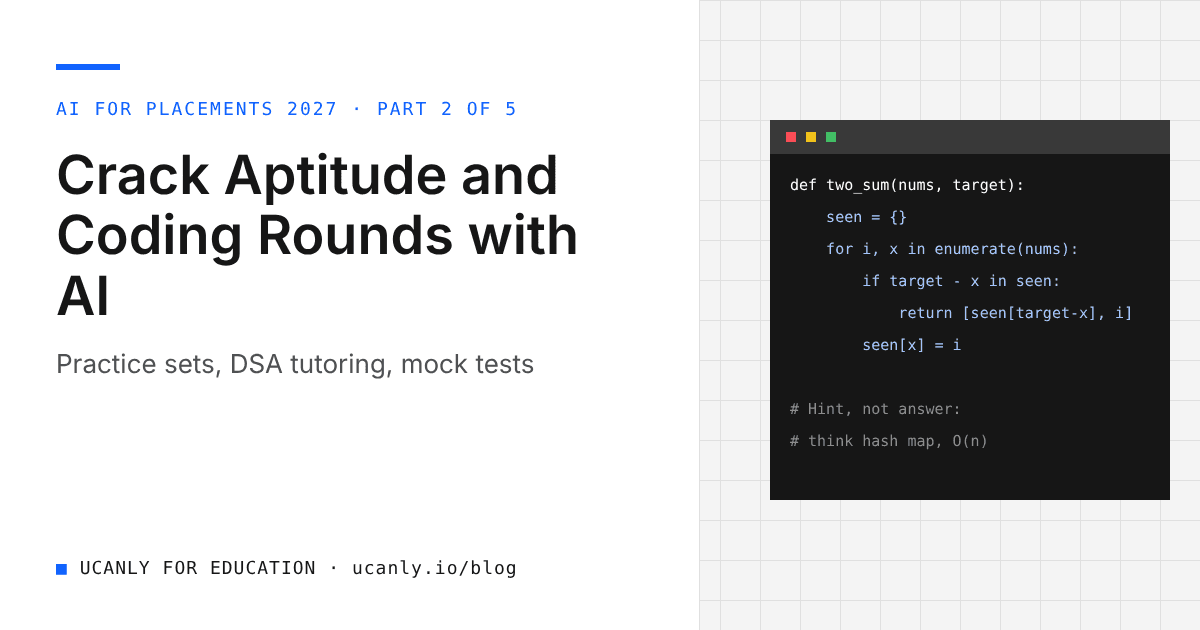
Pasting a problem and copying the solution feels productive, but builds nothing. In a coding round you will be alone with a blank editor, so your practice must simulate that.
Set the rules at the start
Use a reusable tutor prompt at the beginning of every DSA session:
You are my DSA tutor for placement preparation.
Rules:
1. Never give me the full solution or code unless I type "show solution".
2. When I am stuck, give one small hint at a time.
3. Ask me what approach I am considering before hinting.
4. After I solve it, ask me to state the time and space complexity, then correct me.
5. Point out the general pattern this problem belongs to.
Learn patterns, not problems
Hundreds of interview problems collapse into a small number of patterns: two pointers, sliding window, prefix sums, binary search on answer, hashing, stacks for next greater element, BFS and DFS, recursion with backtracking, and dynamic programming. Once you recognise the pattern, the problem becomes manageable.
I just solved "longest substring without repeating characters" using a sliding window. Give me 4 more problems that use the same pattern, in increasing difficulty, without solutions. Then explain how to recognise when a sliding window applies.
Complexity analysis
Interviewers and test platforms both care about efficiency. Make complexity analysis a habit.
Here is my solution. Do not rewrite it. Tell me its time and space complexity, explain which lines dominate the cost, and give me a hint about whether a better complexity is possible.
Dry runs
Dry running by hand is how you catch bugs without a debugger, and it is exactly what you will do in a whiteboard or live coding interview.
I will dry run my binary search on the array [2, 5, 8, 12, 16, 23] searching for 16. I will write the values of low, high and mid at each step. Check my trace and tell me where I go wrong, if anywhere.
You do the work; the AI checks it.
Weak versus strong DSA prompts
Weak: Solve this LeetCode problem in Java.
Strong: I have been stuck on this problem for 25 minutes. My current idea is a nested loop, which is O(n squared) and times out. Without giving code, hint at which data structure could reduce the complexity.
If you want structured DSA fundamentals before practising with AI, our courses cover core data structures and algorithms in a sequenced way.
Build a Mistake Log
The fastest improving students are not the ones who solve the most questions. They are the ones who never repeat the same mistake twice. Keep a simple mistake log in a spreadsheet or notebook with these columns: date, topic, question summary, what I did wrong, the correct idea, and the category of error (concept gap, careless calculation, misread question, time pressure, wrong pattern).
Once a week, paste your log into an AI tool and ask for analysis:
Here is my mistake log from the last two weeks of aptitude and DSA practice. Group my errors by category, tell me my three weakest areas, and create a 7 day revision plan with 45 minutes per day that targets those areas specifically.
Revisit the log before every mock test.
Timed Mock Tests
Knowing how to solve a question is different from solving it in ninety seconds with a timer running. From about the midpoint of your preparation, shift towards timed practice.
Creating a mock
Create a 30 question mixed aptitude mock test: 12 quantitative, 10 logical reasoning, 8 verbal. Mix easy, medium and hard. Show only the questions. I will attempt them in 35 minutes and then paste my answers for evaluation.
For coding, set a timer yourself, pick two problems of differing difficulty from a practice platform, and attempt them with no AI assistance at all. Only after the timer ends should you open an AI chat to review your approach.
Reviewing after the mock
Here are my answers and the time I spent on each section. Evaluate accuracy, tell me which questions I should have skipped earlier, and suggest a section order strategy for the real test.
Track your scores across mocks. Rising accuracy and falling time per question are the signals you want.
Never Use AI During Proctored Online Assessments
This point is not negotiable. Online assessments used in campus and off campus hiring are typically proctored through webcam monitoring, screen and tab tracking, full screen enforcement and plagiarism checks on submitted code. Using ChatGPT, Claude, Gemini, a second device, browser extensions or any outside help during such a test is a violation of the test rules.
The consequences can be severe: disqualification, being blocked from future drives by that recruiter, and in some colleges, action that affects your eligibility for further placements. Even if not caught, the gap shows up in the technical interview. The same rule applies to live interviews: never read AI generated answers during a call.
Integrity also applies beyond tests. Never fabricate projects, internships or skills on your resume. If you want help presenting genuine work clearly, use an honest tool like our AI resume review, which improves how you describe what you actually did.
Think of AI as your gym, not your exam hall.
What to Do Next
Here is a simple plan you can start this week:
- List your syllabus. Confirm the aptitude and coding pattern for your target companies through official career pages and your TPO, not social media rumours.
- Save the tutor prompt. Paste the DSA tutor rules at the start of every coding session so AI gives hints, not answers.
- Practise daily with generated sets. Alternate quantitative, logical and verbal topics, and always attempt before seeing answers.
- Start your mistake log today. Review it weekly with AI and build targeted revision from it.
- Take one timed mock every week, increasing to two or three as placement season approaches.
- Keep AI out of every proctored test and live interview. No exceptions.
If you want a structured plan that connects aptitude, DSA and project work to your target roles, build your personalised career roadmap on Ucanly, and keep reading our blog for the rest of the AI for Placements 2027 series.