If you are in the 2027 batch, you are entering placements at a moment when almost every recruiter assumes you have at least tried AI tools. That assumption cuts both ways. Knowing how to use ChatGPT, Claude or Gemini well is no longer a rare advantage, but using them badly, or claiming more than you can defend, is now easy to spot in an interview. This guide breaks down the AI skills worth building before placement season, the projects that actually show those skills, and how to talk about your AI use honestly.
A quick note before we start: hiring processes, eligibility rules and timelines differ by company and change every year. Always confirm details on official company career pages and through your TPO. Nothing here replaces that.
Why AI fluency is now a baseline, not a bonus
The broad trend across tech hiring is clear even without numbers: teams use AI assistants for writing code, drafting documents, summarising research and debugging. Recruiters increasingly want freshers who can work alongside these tools without becoming dependent on them.
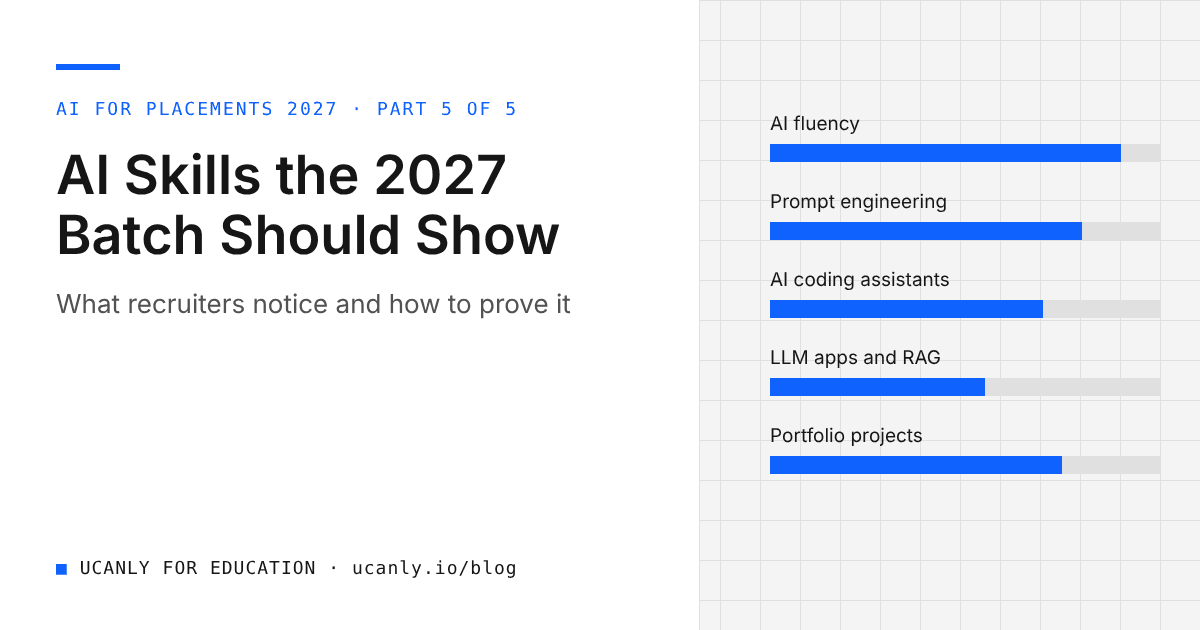
AI fluency, in practical terms, means you can:
- Pick the right tool for the task, for example a chat assistant for explaining a concept, a reasoning model for a tricky logic problem, and documentation for anything version specific.
- Write clear instructions that give context, constraints and the expected output format.
- Verify output by running code, checking sources and spotting confident but wrong answers.
- Know when not to use AI, such as in proctored tests, live coding rounds, or anywhere your college or employer has said no.
That last point matters most. Using any AI tool during an online assessment, a proctored coding test or a live interview is cheating, and it can cost you an offer or a degree. Fluency includes discipline.
Prompt engineering: the skill behind every other skill
Prompt engineering sounds like jargon, but it is really structured communication. The same habits that make a good prompt also make a good bug report, a good email to a manager and a good answer in a technical interview.
The weak prompt versus the strong prompt
Weak: Explain dynamic programming.
Strong: I am a third year CSE student preparing for placements. I understand recursion but get confused about when to use memoisation versus tabulation. Explain the difference using the coin change problem, show both approaches in Python, and end with three practice problems in increasing difficulty. Do not give me the solutions to the practice problems.
The strong version gives your level, the exact confusion, a concrete example, the language and the output shape. It also protects your learning by asking the model to hold back answers.
A reusable template
Context: [who you are and what you are working on]
Goal: [what you want to understand or produce]
Constraints: [language, length, level, what to avoid]
Format: [steps, table, code with comments, checklist]
Check: Ask me two questions before answering if anything is unclear.
Prompts that build real skill
I just solved this LeetCode style problem on my own. Here is my code. Review it like a senior engineer: point out time and space complexity, edge cases I missed, and readability issues. Do not rewrite the whole thing.
Here is a paragraph from my project report. Tell me which claims are vague and what evidence I would need to make them specific. Do not add new claims.
Notice the pattern: you do the work first, and the AI acts as a reviewer or tutor. That is the habit recruiters hope to see.
Using AI coding assistants responsibly
Most students now have access to some form of AI coding help, whether through a chat interface or an assistant inside the code editor. The difference between a strong and weak candidate is not whether they use these tools, it is whether they understand every line they commit.
Rules worth following
- Never commit code you cannot explain. If an interviewer points at any function in your project, you should be able to walk through it.
- Read the generated code before running it. Look for hardcoded secrets, deprecated libraries and logic that only handles the happy path.
- Write tests yourself, or at least review the tests the AI writes. Tests are where you prove you understand the expected behaviour.
- Keep API keys out of your code and your prompts. Use environment variables, and never paste credentials into a chat window.
A responsible debugging prompt
Weak: Fix this error. [pastes 300 lines]
Strong: My Flask app returns a 500 error when I submit the login form. Here is the route function and the full traceback. Explain what the traceback means first, list the two most likely causes, and suggest how I can confirm each one. I want to fix it myself after understanding it.
Basic LLM app building: what freshers should understand
You do not need to train models to show AI skills. What stands out is the ability to build a small, working application on top of an existing model, and to explain the design choices.
Calling a model through an API
At a high level, an LLM API works like any other web API: you send a request with your instructions and input, and you receive generated text back. The concepts worth understanding are:
- System and user messages, which separate standing instructions from the user's question.
- Tokens and context limits, which explain why you cannot paste an entire textbook into one request.
- Temperature and similar settings, which control how varied the output is.
- Cost and rate limits, which force you to design efficiently.
RAG at a high level
Retrieval augmented generation, usually shortened to RAG, is a pattern where your app first searches your own documents for relevant passages, then passes those passages to the model along with the question. This lets the model answer from your data instead of guessing.
The simple version has four steps: split documents into chunks, convert chunks into embeddings, retrieve the closest chunks for a question, and ask the model to answer only from those chunks. If you can draw this on a whiteboard and explain where it can fail, you are ahead of many candidates.
Explain retrieval augmented generation to me as if I am preparing for a fresher interview. Then give me three ways a RAG app can give wrong answers and how a developer might reduce each one.
Three portfolio projects that stand out for placements 2027
These three ideas show judgement, not just API calls. Build at least one, deploy it, and document it well.
1. A syllabus aware study assistant
Load your own course notes or publicly available lecture material (respect copyright and your college's rules) and build a RAG app that answers questions with citations to the source page. Add a mode that generates practice questions without answers.
What it shows: retrieval, prompt design, citation handling and an honest UI that says "I could not find this in the notes" instead of inventing answers.
2. A resume and job description gap analyser
Build a tool where a user pastes a job description and their own resume, and the app lists skills that appear in the description but are not evidenced in the resume. The key design rule: the tool must never write fake experience, only suggest what to learn or how to describe real work more clearly.
What it shows: structured output, guardrails and an understanding of ethical AI. You can compare your tool's suggestions with what you get from Ucanly's AI resume review and discuss the differences in your README.
3. An evaluation harness for your own prompts
Pick one task, such as summarising news articles or classifying support tickets. Write twenty test inputs with expected outputs, run several prompt versions against them, and record which version performs best and why.
What it shows: this is the least common and most impressive of the three. It proves you understand that AI output must be measured, not trusted.
Make every project interview ready
For each project, write a README that covers the problem, your architecture, what the AI does versus what your code does, known limitations, and what you would improve. If you want structured help with the fundamentals behind these projects, our courses cover backend, APIs and core CS topics step by step.
How to talk about AI use in interviews without overclaiming
Interviewers are increasingly asking candidates directly how they used AI in their projects. A vague or defensive answer hurts more than an honest one.
What not to say
- "I built an AI model" when you called an existing API.
- "I am an expert in prompt engineering" with nothing to show for it.
A better structure
Describe what you built, where AI helped, what you decided yourself, and how you verified it. For example:
"I built a RAG based study assistant using an existing LLM API. I used an AI assistant to scaffold the initial Flask routes, then rewrote the retrieval logic myself after it returned irrelevant chunks. I tested it on fifty questions from my notes and added a fallback message when confidence was low."
That answer is specific, honest and shows ownership.
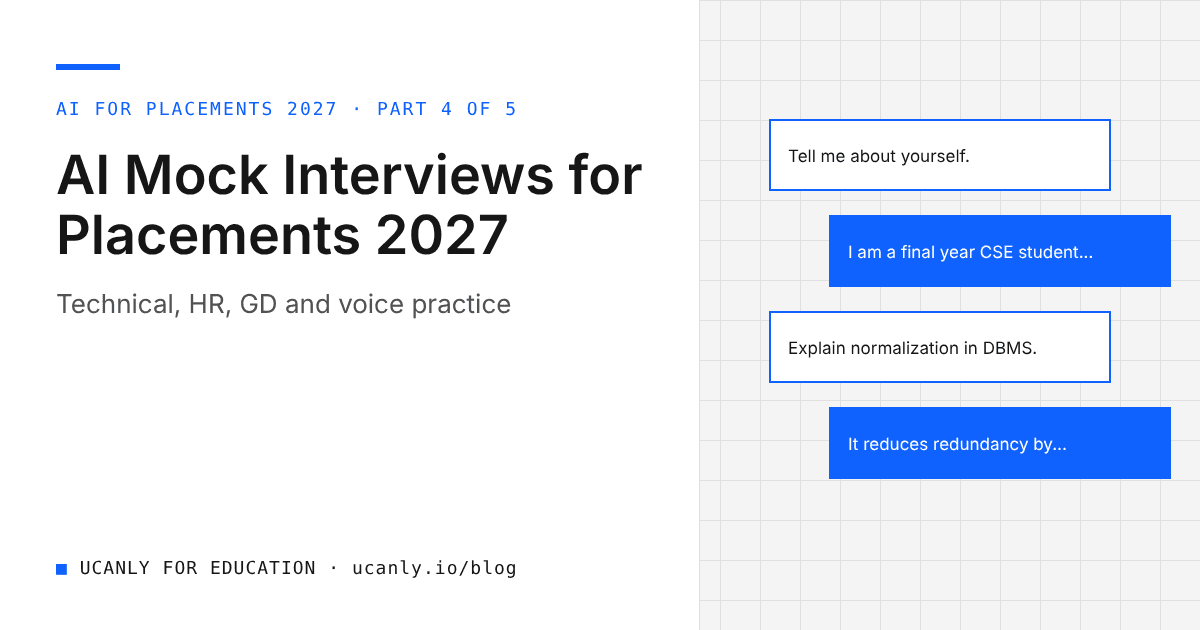
Practise with AI, then without it
Act as a technical interviewer for a fresher software role. Ask me five follow up questions about my project, which I will describe below. Push back if my answers are vague. After the session, list the weakest parts of my explanation.
Use this for practice only. In the real interview, it is just you.
Putting it all together
The 2027 batch does not need to become AI researchers. What recruiters want to see is a candidate who uses AI tools thoughtfully, builds real things, verifies everything and talks about it honestly.
Here is what to do next:
- This week: rewrite three of your usual prompts using the context, goal, constraints and format template.
- This month: pick one of the three portfolio projects, build a working version and deploy it.
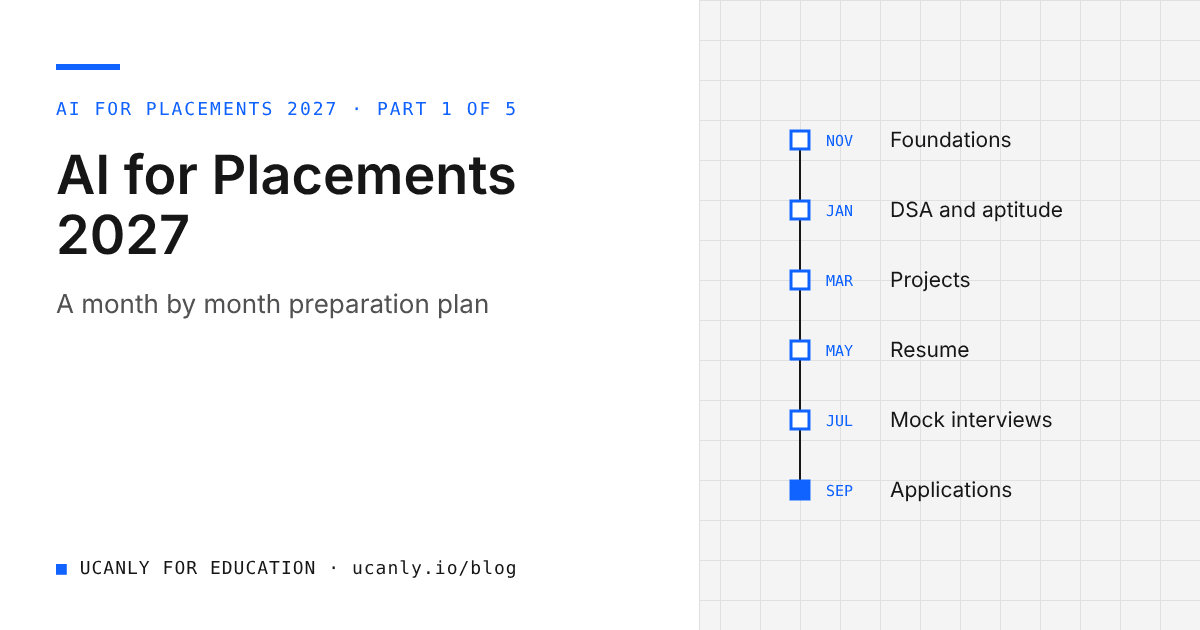
- Before placement season: write a clear README, rehearse your project explanation, and run your resume through an honest review.
- Always: confirm company processes with your TPO and official career pages, and never use AI in proctored tests or live interviews.
If you want a structured plan for the months ahead, create a free career roadmap on Ucanly, and keep an eye on the jobs board for roles where these skills fit.