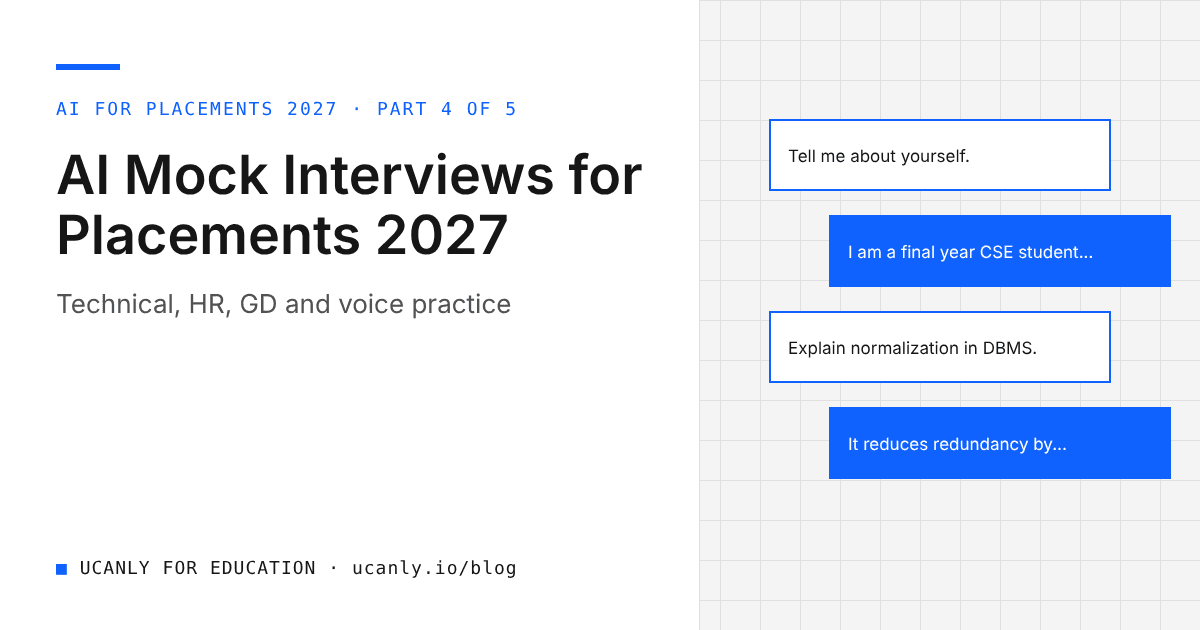
Most students in the 2027 batch do not fail interviews because they lack knowledge. They fail because they have never said that knowledge out loud, under time pressure, to someone asking follow up questions. Reading notes on normalization is not the same as explaining it clearly when an interviewer says "okay, now tell me why we would ever denormalize." Free AI apps like ChatGPT, Claude and Gemini can close that gap. Used well, they become a patient practice partner available at midnight before your campus drive. Used badly, they become a crutch that makes you sound rehearsed. This guide shows you how to run proper mock interviews with AI, including voice practice, and how to stay on the right side of integrity.
Why AI Mock Interviews Work (And Where They Fall Short)
An AI interviewer asks unlimited questions, adapts follow ups to your answer, and never gets bored.
It has limits too. Real panels vary by company and interviewer, AI explanations are occasionally confidently wrong, and most assistants praise average answers unless told to be strict. Treat AI as a sparring partner and verify technical facts against textbooks or official documentation.
Setting Up a Technical Interview Drill
The quality of the mock depends on the quality of your setup prompt. Compare these two.
Weak prompt:
Ask me some DBMS interview questions.
This produces questions with answers attached, which is passive reading.
Strong prompt:
Act as a technical interviewer for a fresher software engineer role at a product company in India. Interview me on DBMS. Ask one question at a time and wait for my answer. After each answer, ask one follow up question that goes deeper, the way a real interviewer would. Do not give me the correct answer until I say "review". Keep difficulty at a level suitable for a final year BTech student.
One question at a time, follow ups, and no answers until review: that structure turns a chatbot into an interviewer.
Covering the Core CS Subjects
Rotate through the four subjects most campus technical rounds draw from. Use a focused prompt for each.
OOP:
Interview me on object oriented programming using Java. Start with the four pillars, then move to practical questions such as when to prefer composition over inheritance and how method overloading differs from overriding. Ask me to give a small real world example for each concept.
DBMS:
Interview me on DBMS fundamentals: keys, normalization up to BCNF, joins, indexing, transactions and ACID properties. Include at least two questions where I must write an SQL query in words, for example finding the second highest salary in an employee table.
Operating Systems:
Interview me on operating systems: processes versus threads, CPU scheduling algorithms, deadlock conditions and prevention, paging and virtual memory. If my answer is vague, ask me to explain with an example scenario.
Computer Networks:
Interview me on computer networks: the OSI and TCP/IP models, TCP versus UDP, what happens when I type a URL in the browser, DNS, and HTTP versus HTTPS. Push me on the "what happens when I type a URL" question until my explanation is complete and in the right order.
If a subject keeps exposing gaps, revise it properly through structured courses rather than chat explanations alone.
Drilling Your Own Projects
Interviewers often spend more time on your projects than on theory, because projects reveal what you actually built.
Here is a description of my final year project: [paste a short, honest description, your role, the tech stack, and one problem you solved]. Act as an interviewer who is sceptical and curious. Ask me ten questions, one at a time, about design decisions, trade offs, what I would improve, how I tested it, and what exactly I personally built versus my teammates.
If you cannot answer a question about your own project, that is a signal to go back to the code, not to invent an answer. Never claim work you did not do, on your resume or in the interview. A good project description in your resume should hold up under exactly this kind of questioning; running it through an AI resume review alongside your mock drills helps you keep both consistent and truthful.
HR Rounds and Behavioural Questions
HR rounds look easy and are routinely underprepared. Expect questions on your introduction, strengths and weaknesses, conflict, relocation, and why this company.
Weak prompt:
Give me a good answer for "tell me about yourself".
You will get a polished, generic script that sounds like everyone else.
Strong prompt:
I will answer the question "tell me about yourself" for a fresher role. Here is my answer: [paste your own answer]. Evaluate it for clarity, structure, length (it should take about one to two minutes when spoken), and relevance to a software role. Point out filler phrases and anything that sounds memorised. Suggest improvements, but keep my own words and experiences. Do not add achievements I did not mention.
That last line matters. AI tools love to "improve" stories by adding impact that never happened. Keep your answers honest, because HR interviewers ask follow ups too.
For behavioural questions, ask the AI to coach you in the STAR format (Situation, Task, Action, Result):
Ask me five behavioural questions typical for campus HR rounds, one at a time, such as a time I handled a disagreement in a team project or a time I missed a deadline. After each of my answers, tell me which part of STAR was weak or missing.
Group Discussions and Communication Practice with Voice Mode
Typing answers is not enough, because interviews and group discussions test spoken communication. The voice modes in the ChatGPT, Claude and Gemini mobile apps let you practise speaking.
Running a Voice Mock
Open the voice mode in your app and say something like:
Be my interviewer for a fresher HR round. Ask me one question at a time. Let me finish speaking before you respond. After five questions, give me feedback on my clarity, pace, confidence and use of filler words like "basically" and "actually".
Use earphones and a quiet room, and record yourself separately with your phone so you can hear habits the AI misses. If your spoken English needs work, a daily fifteen minute voice session builds fluency faster than reading.
Simulating a Group Discussion
AI cannot recreate a crowded room, but it can train opening, structuring, building on others and summarising.
Simulate a group discussion on the topic "Should AI tools be allowed in college exams?" Play three other participants with different views: one strongly in favour, one strongly against, and one who keeps going off topic. Give each a short opening point. Then let me respond. Continue for four rounds, and at the end evaluate how well I added new points, acknowledged others, and summarised.
Use voice mode so you practise speaking up.
Feedback Rubrics That Actually Help
Vague feedback like "good answer, could be more detailed" is useless. Give the AI a rubric so its evaluation is consistent across sessions and you can track progress.
Evaluate my answer on a 1 to 5 scale for each criterion:
1. Correctness: are the technical facts accurate?
2. Depth: did I explain why, not just what?
3. Structure: was the answer organised and easy to follow?
4. Examples: did I use a relevant, concrete example?
5. Communication: was it concise, without filler or rambling?
For any score below 4, quote the exact part of my answer that caused it
and show what a stronger version would include. Be strict, as a real
interviewer at a competitive company would be.
Log the date, subject, scores and two biggest mistakes after each session. Within a few weeks you will see patterns and can target practice.
Researching a Company's Interview Process Responsibly
AI can help you organise research on a company, but it should never be your only source.
Do this:
- Read the official careers page and the job description the company or your TPO shares.
- Attend the pre placement talk and note the rounds they describe.
- Talk to seniors from your college who went through the same process.
- Use AI to turn the job description into a practice plan.
Here is the job description shared by our placement cell: [paste it]. Based only on the skills and responsibilities listed, create a seven day mock interview plan covering the likely technical topics and HR themes. Do not guess the company's internal interview rounds.
Avoid this:
- Asking AI for "the exact questions Company X asks" and trusting the answer. Models may produce outdated or invented details.
- Treating anonymous forum posts as official information about dates, eligibility, packages or rounds.
- Seeking leaked papers or answer keys from recent tests. That is an integrity violation and can get you debarred from placements.
For dates, eligibility criteria, rounds and offer details, always confirm on official company channels and with your training and placement officer. To explore openings beyond campus, check the jobs board and read each listing's requirements carefully.
Why You Should Never Use AI During Live Interviews
Some students are tempted to keep an AI app open during an online interview. Do not do it.
- It is dishonest. An interview tests your ability. Passing off AI output as your own thinking misrepresents you to the employer.
- It gets noticed. Interviewers notice delayed answers, eyes moving across a screen, and answers that sound written rather than spoken. Many online assessments and interviews are proctored.
- The consequences are serious. Being caught can mean disqualification, a rescinded offer, or action from your college placement cell.
The same rule applies to proctored aptitude tests and coding rounds. AI is for preparation, before the interview. During the interview, it is just you, and that is exactly why the practice matters.
What to Do Next
Start this week with a simple routine:
- Pick one CS subject and run a strict text based mock using the interviewer prompt above.
- Write an honest description of your best project and let the AI question you on it until you can answer every follow up.
- Do one voice session for "tell me about yourself" and record yourself.
- Use the rubric after every session and log your scores.
- Verify technical answers against reliable sources, and confirm company details only through official and TPO channels.
Consistency beats intensity. Thirty focused minutes a day for a month will change how you sound in a real interview. If you want a structured path for what to learn and in what order, create your free career roadmap and plan your preparation around it.