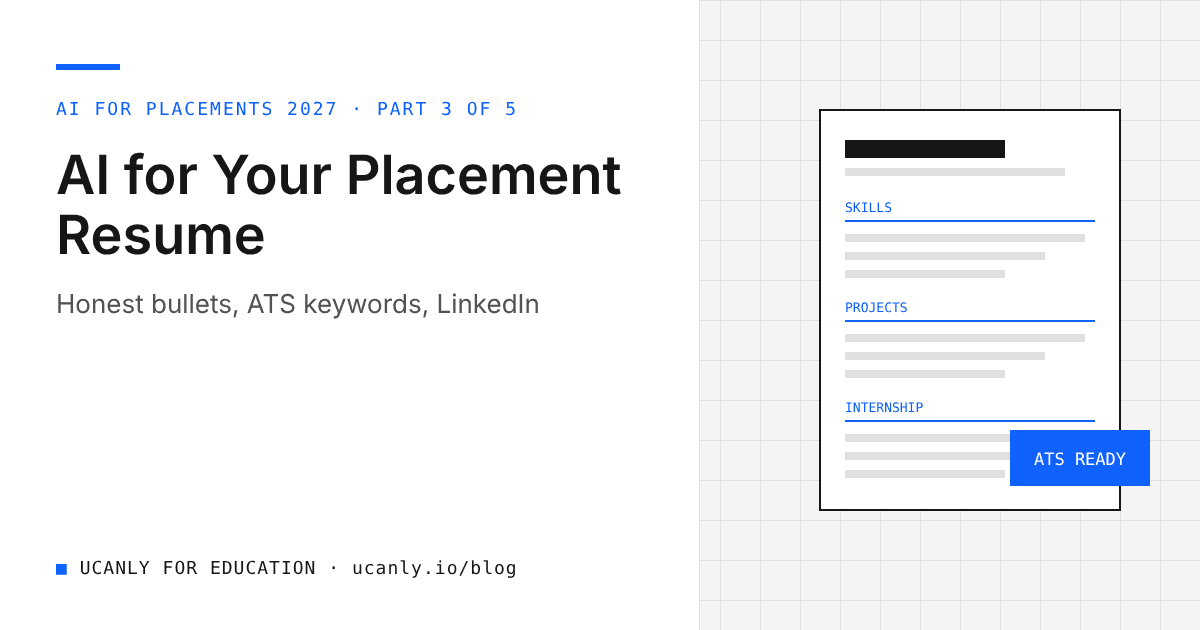
Your resume is usually the first thing a recruiter or a placement cell filter sees, and for most 2027 graduates it is also the weakest part of their preparation. Free AI tools like ChatGPT, Claude and Gemini can change that, but only if you use them as an editor and a reviewer, not as a ghostwriter that invents a better version of you. This guide walks through a practical workflow: building a one page fresher resume, writing honest bullets, aligning keywords per role, cleaning up LinkedIn and GitHub, tailoring for each company, and avoiding the signs of AI writing that recruiters now spot quickly.
The ground rule: AI polishes, it never invents
Before any prompt, fix one rule in your mind. Every line on your resume must be something you can explain in an interview for five minutes. If AI adds a technology you never used, a metric you never measured, or a responsibility you never had, that line becomes a liability. Interviewers pick a project and go deep, and a fabricated bullet collapses under two follow up questions.
So treat AI as a strict editor. You supply the facts. The tool improves clarity, structure and wording. Make that explicit in every prompt:
Use only the facts I give you. Do not add tools, numbers, or outcomes that I have not mentioned. If something is missing, ask me a question instead of assuming.
That single instruction prevents most of the problems this article covers.
Building a one page fresher resume with AI
Start with a raw fact dump, not a template
Write everything down without worrying about format: education with CGPA, projects, internships, certifications, hackathons, coding profiles and positions of responsibility. Then ask the AI to organise it.
Weak prompt:
Make me a resume for a software engineer job.
Strong prompt:
I am a 2027 BTech CSE student in India applying for fresher software engineering roles through campus and off campus placements. Below is a raw list of my education, projects, internship, skills and achievements. Organise it into a one page resume structure with these sections in this order: Education, Technical Skills, Projects, Experience, Achievements. Keep only what is relevant for software roles. Use only my facts. Flag anything that looks weak or vague and ask me questions about it.
[paste your raw notes]
Keep it to one page
For freshers, one page is the norm. Ask the AI to help you cut, not expand:
This resume is running over one page. Suggest what to remove or shorten, ranked from least valuable to most valuable for a fresher backend developer role. Explain each suggestion in one line.
Typical cuts are school level achievements, generic soft skill lists, objective statements, and courses that duplicate your skills section. Keep a single column layout with standard section names and no graphics.
Turning projects and internships into strong, honest bullets
A good bullet answers three things: what you built or did, how you did it, and what changed because of it. Most student bullets only say what the project was.
Before: "Made an e commerce website using MERN stack."
After (honest version): "Built a shopping web app with React and Node.js featuring cart, login with JWT, and order history; deployed on Render and tested by 15 classmates during a college fest."
The second version is stronger only because the facts behind it are true. Use a prompt that pulls those facts out of you:
Here is a project from my resume: [paste description]. Ask me up to 6 questions about what I personally built, which tools I used, what problems I solved, and any real outcome I can measure or observe. Do not write bullets yet.
After you answer, follow up with:
Now write 3 resume bullets from my answers. Start each with a strong action verb, keep each under 25 words, and use only numbers I actually gave you. If I gave no number, describe the outcome qualitatively instead.
What if you have no metrics?
Many college projects have no users or measurable impact. That is normal. Do not invent "improved performance by 40 percent". Instead describe scope and specifics honestly: number of features, the data size you handled, the APIs you integrated, the test cases you wrote, or the problem you debugged. Real specifics read better than fake numbers.
Internships, including short or unpaid ones
For internships, separate what the team did from what you did:
I interned for 8 weeks at a small startup. Here is everything the team worked on and here is what I personally did: [paste]. Write 2 to 3 bullets that describe only my contribution, without implying I led or owned work that the team did.
ATS keyword alignment for each role
Many companies and placement portals use applicant tracking systems that scan resumes for relevant skills before a human reads them. The goal is not to stuff keywords but to make sure the skills you genuinely have are named the way the job description names them.
Here is a job description for a fresher data analyst role and here is my resume. List the important skills and tools in the job description. For each one, tell me whether my resume shows it clearly, shows it weakly, or does not show it. Do not rewrite anything yet.
This gives you a gap list. Then act on it honestly:
- Shown weakly: rephrase so the exact term appears, for example writing "SQL" explicitly if your project used PostgreSQL queries.
- Not shown but you have it: add it where it naturally fits, in a project bullet or skills line.
- Not shown and you do not have it: do not add it. Put it on your learning list instead. Structured courses can help you close a real gap before the next application.
Keep a master resume with everything, and derive role specific versions from it: DSA and frameworks for developer roles, SQL and dashboards for analyst roles.
If you want a second opinion beyond a chatbot, run your draft through an AI resume review built for Indian fresher roles, and compare its feedback with your own gap list.
Cleaning up LinkedIn and GitHub
Recruiters often check your profiles after the resume, and inconsistencies create doubt.
Here is my resume and my current LinkedIn headline and About section. Write 3 headline options under 220 characters for a 2027 graduate seeking software roles, and an About section of 4 short paragraphs in first person. Keep the tone professional and plain. Use only facts from my resume.
Then confirm dates and titles match your resume exactly.
GitHub
Pin your three to six best repositories. Each pinned repository needs a README that explains what the project does, the tech stack, how to run it, and screenshots if it has a UI. AI is genuinely useful here:
Here is the folder structure and main files of my project. Write a README with these sections: Overview, Features, Tech Stack, Setup Instructions, Screenshots placeholder, What I Learned. Keep it accurate to the code I shared and do not claim features that are not implemented.
Also clean up: delete or make private any copied tutorial repositories with no changes, give repositories clear names, and make sure the links on your resume open the right repository.
A per company tailoring workflow
Sending the same resume to every company wastes your strongest material. A simple 20 minute workflow per application works well:
- Read the job description yourself first. Note the role, required skills and anything the company emphasises.
- Run the gap prompt from the ATS section against your master resume.
- Reorder projects so the most relevant one comes first.
- Adjust the skills line to lead with the tools the role asks for, only if you have them.
- Rewrite one or two bullets to emphasise the relevant angle of the same true work.
- Run a final check:
Compare this tailored resume with my master resume. List every claim in the tailored version that does not appear in the master version. I want to confirm nothing new was invented.
- Save the version with the company name and date, so you know exactly what you sent before the interview.
Track applications in a simple sheet. Browse openings on the jobs board, and always confirm eligibility criteria, dates and process details on official company pages and your TPO channels rather than on forwarded messages.
Red flags of AI written resumes that recruiters notice
AI generated resumes have become easy to recognise. Watch for these:
- Buzzword clusters: words like "spearheaded", "leveraged", "synergy", "cutting edge" and "passionate" stacked together, especially for a two week project.
- Suspiciously round metrics: every bullet with "improved efficiency by 30 percent" when there was no way to measure it.
- Identical structure everywhere: every bullet the same length and rhythm, which reads as generated.
- Mismatched seniority: a fresher describing "architecting scalable enterprise solutions".
- Generic summaries: a profile summary that could belong to anyone in the batch.
- Tools you cannot explain: Kubernetes, Kafka and microservices listed for a college attendance app.
Ask the AI to audit its own output:
Review this resume as a strict technical recruiter in India hiring freshers. Point out any lines that sound exaggerated, generic, or AI generated, and any claim a fresher would struggle to defend in an interview. Suggest plainer wording for each.
Then read every line aloud. If it does not sound like you, rewrite it in your own words.
One more integrity note: your resume is your work to prepare with any honest help you like. Online assessments and interviews are different. Never use AI tools during proctored tests or live interviews.
What to do next
Start this week with a raw fact dump of everything you have done, then use the prompts above to build a clean one page master resume. Rewrite your project and internship bullets with the question first approach, and refuse any number you cannot back up. Run a keyword gap check against two or three real job descriptions, fix your LinkedIn and pin your best GitHub repositories with proper READMEs. From then on, tailor every application using the seven step workflow and save each version.
If you want a structured path alongside this, build a personalised career roadmap and keep reading the blog for the rest of the AI for Placements 2027 series. An honest, specific resume will not guarantee a shortlist, but it gives every interview a strong, defensible starting point.