If you graduate in 2027, the next eight months will decide how ready you are when the right company opens its form. Some of your campus drives may already be live, others will come later, and off campus hiring runs through the year. The students who do well are rarely the ones who studied the most hours. They are the ones who followed a plan, measured progress every week, and used tools intelligently. This guide gives you that plan, month by month from November 2026, with the exact AI prompts to use in each phase and a weekly routine you can actually keep.
One rule before we start: AI is your tutor, reviewer and practice partner. It is never your answer key during a proctored test or a live interview, and it never writes anything on your resume that you did not do. Every phase below is built around that rule.
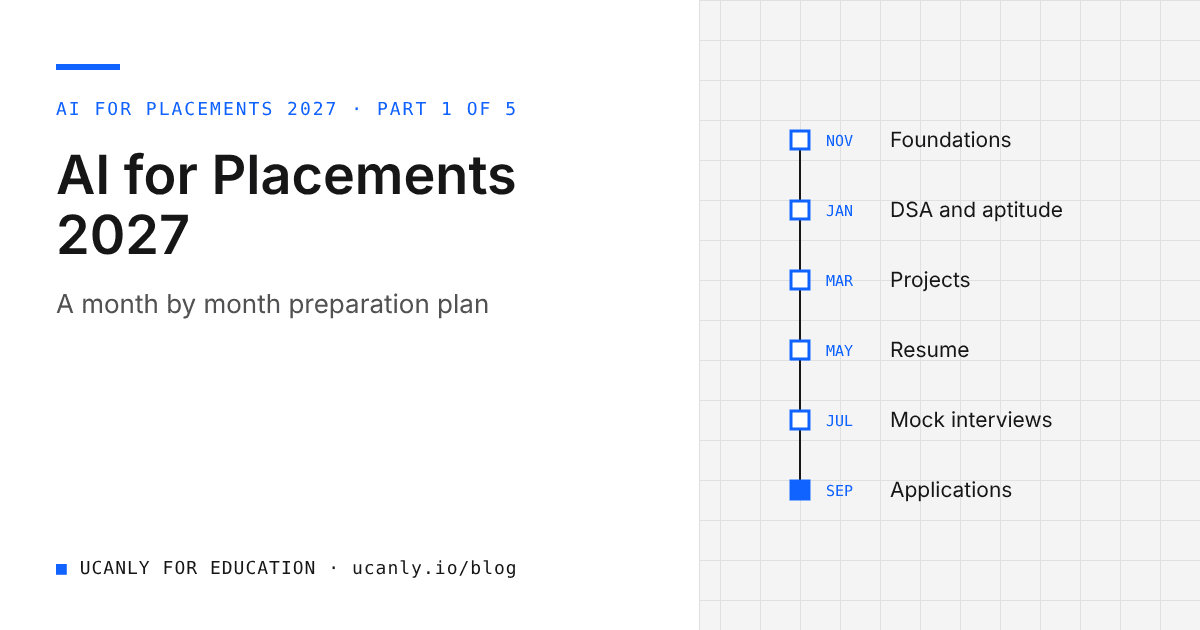
The six phases at a glance:
- November 2026, foundations: core subjects and one language.
- December 2026 to January 2027, DSA and aptitude: patterns and timed speed.
- February 2027, projects: one or two you can explain line by line.
- March 2027, resume: truthful and role specific.
- April 2027, mock interviews: technical, project and HR rounds.
- May 2027 onwards, application season: consistent, tracked applications.
Treat the months as a backbone, not a cage. If your college drives are already running, compress the early phases and apply while you keep preparing. Placement timelines, eligibility criteria and company processes differ by college and by year. Always confirm dates and rules on official company career pages and through your TPO, not through forwarded messages.
Phase 1, November 2026: Foundations
Many students jump into problem solving and then get stuck on recursion, pointers or SQL joins. Spend November fixing the base: one programming language (C++, Java or Python), OOP concepts, DBMS, operating systems and computer networks at interview depth.
Use AI to find your gaps, not to read notes for you.
Weak prompt:
Explain operating systems.
Strong prompt:
I am a final year B.Tech CSE student preparing for campus placements. Ask me 10 interview level questions on operating systems, one at a time. After each answer I give, tell me what was correct, what was missing, and rate my answer out of 5. Do not reveal the answer before I attempt it.
This turns the chatbot into a viva examiner. Repeat it for DBMS, OOP and networks, and note every concept scored below 3.
If you prefer structured learning over scattered videos, pick one track from our courses and use AI only to clarify doubts inside that track.
Phase 2, December 2026 to January 2027: DSA and Aptitude
These two months carry the most weight because online assessments filter many candidates early.
DSA: learn patterns, not problems
Group your practice by pattern: arrays and hashing, two pointers, sliding window, stacks, binary search, linked lists, trees, graphs, and basic dynamic programming. Solve on your own first, with a fixed time limit. Only then bring in AI.
Weak prompt:
Give me the code for longest substring without repeating characters.
Strong prompt:
I tried "longest substring without repeating characters" for 30 minutes. My approach checks every substring and gets time limit exceeded. Do not give me code. Give me one hint at a time about a better approach, and wait for my reply before the next hint.
Prompt for reviewing an accepted solution:
Here is my accepted Java solution. Explain its complexity, list edge cases it might miss, and ask me 2 follow up questions an interviewer might ask.
Prompt for pattern revision on Sunday:
I solved these 8 problems this week: [list names]. Group them by pattern, write a one line trigger for each pattern (the clue in a question that suggests it), and quiz me by describing 3 new problems in words so I can identify the pattern.
Aptitude: speed comes from shortcuts plus timing
Quantitative aptitude, logical reasoning and verbal ability are where many good coders lose marks. Use AI to generate practice sets and explain methods, then time yourself without it.
Create 15 aptitude questions on time and work, profit and loss, and percentages at the level of an Indian campus placement online test. Give options for each. Do not show answers until I reply with mine. Then explain the fastest method for each one I got wrong.
Then practise full timed sections with no AI open, because real exams do not allow assistants.
Phase 3, February 2027: Projects
A project you cannot explain is worse than no project. Build one or two solid ones related to your target roles, not five tutorial clones.
Prompt for choosing a project:
I am targeting backend developer roles as a 2027 graduate. I know Java, Spring Boot basics and MySQL. Suggest 3 project ideas that solve a real problem for Indian college students, can be built in 4 weeks, and would give me good interview discussion points. For each, list the core features and one technical challenge.
Prompt for design thinking:
Here is my project plan: [paste]. Act as a senior engineer reviewing it. Ask me questions about database design, API structure, authentication and error handling. Point out weak decisions but let me propose fixes first.
You may use AI to debug and learn, but write the code yourself and understand every line. If an interviewer asks why you chose a particular database or library, "the chatbot suggested it" is not an answer.
Phase 4, March 2027: Resume
By March you have real content: projects, skills, perhaps an internship or hackathon. Now shape it into a one page resume that passes both software screening and a human reader.
Weak prompt:
Make my resume impressive.
Strong prompt:
Here is my resume text and a job description for a graduate software engineer role. Do not add any skill, tool, metric or experience that is not already in my resume. Rewrite my bullet points to start with strong action verbs, make them specific, and match relevant keywords from the job description only where they are true for me. Flag any bullet that is vague and ask me questions to make it concrete.
Prompt for gap checking:
Compare my resume with this job description. List requirements I meet, partially meet, and do not meet. For gaps, suggest what I could learn in 3 weeks, not how to hide them.
Never invent numbers, users, internships or certifications. Background checks and technical rounds expose fabrication quickly, and it can cost you an offer. Run your final draft through Ucanly's AI resume review to catch formatting and clarity issues, then keep separate versions for different role types.
Phase 5, April 2027: Mock Interviews
AI is an excellent practice interviewer when you use it for rehearsal. Do mocks in three formats: technical, project discussion and HR.
Technical mock prompt:
Act as a technical interviewer at a product company hiring freshers. Ask me one DSA question suited to a 45 minute interview. Let me explain my approach in words first. Challenge my approach, ask about complexity, and ask one follow up variation. At the end, give me honest feedback on communication and problem solving.
HR round prompt:
Ask me common HR questions for Indian campus placements one by one, including "tell me about yourself", "why should we hire you", and a question about a failure. After each answer, tell me if it was too long, too generic, or missing a specific example, and suggest how to structure it using the STAR method.
Speak your answers out loud, and do a few mocks with seniors or faculty too. AI cannot judge your body language or pace.
And once more: when the real interview begins, close every assistant. Using AI during a live interview or a proctored assessment is dishonest, often detectable, and can get you blacklisted from a company or barred by your placement cell.
Phase 6, May 2027 Onwards: Application Season
Now preparation becomes execution: keep revising DSA lightly and apply consistently.
Track every application in a simple sheet: company, role, source, date, status and next step.
Prompt for a short outreach note:
Write a polite 80 word LinkedIn message to a senior from my college who works as a software engineer at [company]. I want to ask for 15 minutes of advice about their hiring process, not a referral directly. Keep it respectful and specific.
Prompt for interview research:
Summarise what [company] does and suggest 5 questions I could ask my interviewer. Mark anything you are unsure about so I can verify it on the official website.
Look for openings on the Ucanly jobs board, on official career pages, and through your TPO. Treat any role that asks for a payment to "guarantee" placement as a red flag.
Your Weekly Routine
A plan works only if it fits a week. Here is a routine for a student with regular college hours. Adjust times, but keep the structure.
- Monday to Friday, morning (1 hour): core subject revision or aptitude practice, timed, without AI.
- Monday to Friday, evening (1.5 to 2 hours): DSA by pattern. Attempt alone first, then use hint based prompts for problems you could not crack.
- Saturday (3 hours): one full timed mock test without AI, followed by an AI assisted review of every mistake.
- Sunday (2 hours): pattern revision prompt, one AI mock interview, and planning the next week.
- Every day (10 minutes): log what you did and what confused you. This log becomes your revision list.
Prompt for the Sunday review:
Here is my study log for this week: [paste]. Identify my weakest areas, tell me whether I am behind my plan, and create next week's schedule with specific topics for each day. Keep it realistic for a student with college classes.
If you want a personalised version of this plan based on your target role and current skills, build your career roadmap on Ucanly and use it alongside these prompts.
What to Do Next
Start today, not on the first of the month. This week, pick your language, run the operating systems and DBMS examiner prompts, and note your weak areas. Set up your daily log and block the Saturday mock slot in your calendar. Confirm your college's placement schedule and eligibility rules with your TPO, and check official career pages for off campus openings.
Use AI to ask better questions, get faster feedback and practise more often. Keep it out of tests and interviews, and keep your resume honest. Follow the phases, review every Sunday, and by the time application season peaks you will walk in prepared, not hoping.