If you are a student in India, you have heard "machine learning" in placement talks, internship listings and final year project ideas. Most beginner material either drowns you in maths or skips to copying code you do not understand. This guide sits in the middle: what machine learning is, the main types, the vocabulary interviewers expect, the workflow real projects follow, and your first model in a few lines of Python on Google Colab.
What Machine Learning Actually Is
Machine learning is a way of building software where, instead of writing the rules yourself, you give the computer examples and let it learn the rules from data.
Traditional programming vs machine learning
In traditional programming, you write explicit logic:
- Input: data plus rules written by you
- Output: answers
A college attendance checker is a good example: if attendance is below 75 percent, mark the student "not eligible". The rule is clear, so plain code works.
In machine learning, the arrangement flips:
- Input: data plus the answers you already know
- Output: the rules (a trained model)
Now imagine predicting whether a student will clear a coding round from CGPA, problems solved and mock interview scores. Nobody can write a neat rule for this, but given past records with outcomes, an algorithm can find the patterns.
Key takeaway: Use traditional programming when you can write the rules. Use machine learning when the rules are too complex, too many, or keep changing, but you have enough examples.
A good interview answer to "What is machine learning?" is exactly this contrast, followed by one concrete example from your own experience or project.
The Vocabulary You Must Know
These terms appear in every course, library and fresher interview.
- Dataset: a table of examples. Each row is one example (one student, one flower, one house).
- Features: the input columns the model uses to make a decision. For a placement predictor: CGPA, problems solved, internships done. Usually written as
X. - Label (or target): the answer you want to predict, such as "placed" or "not placed". Usually written as
y. - Training: the process where the algorithm looks at features and labels and adjusts its internal numbers (parameters) to reduce mistakes.
- Model: the result of training. It is a function that takes new features and returns a prediction.
- Prediction: the output the model gives for an example it has not seen before.
- Training set and test set: you split your data. The model learns from the training set and is judged on the test set, which it never saw during training. This checks whether it learned something general or simply memorised.
Key takeaway: Features go in, a label comes out. Training builds the model, the model makes predictions, and the test set tells you whether to trust them.
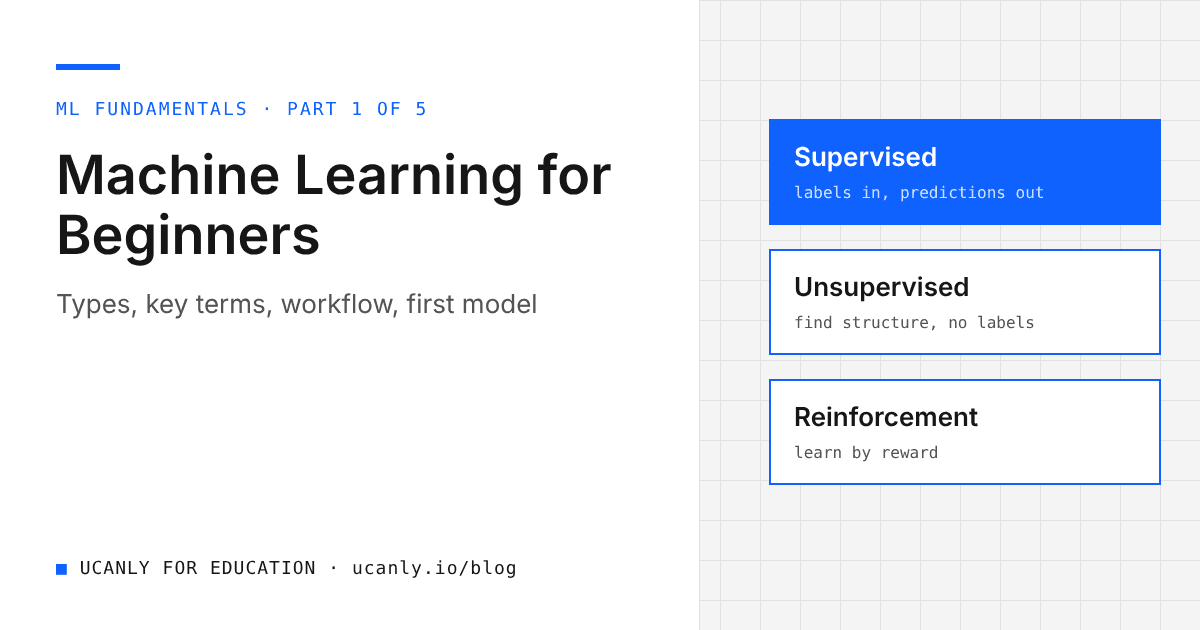
The Three Main Types of Machine Learning
Supervised learning
In supervised learning, every training example comes with the correct answer (the label). The model learns the mapping from features to label. There are two main flavours.
Classification predicts a category.
- Is this email spam or not spam?
- Which of three iris species is this flower?
Regression predicts a number.
- What will this flat in Bengaluru rent for per month?
- What score will a student get next semester?
If the answer is a category, it is classification; if it is a continuous quantity, it is regression. Interviewers love asking "Is predicting a CGPA classification or regression?" (regression) and "Is predicting pass or fail classification or regression?" (classification).
Unsupervised learning
Here you have features but no labels. The model looks for structure on its own. The most common task is clustering: grouping similar examples together.
Examples:
- Grouping students on a learning platform by study behaviour, so each group gets a different study plan
- Segmenting customers of an online store by buying habits
The algorithm only says "these items look similar". A human still interprets what each group means.
Reinforcement learning
In reinforcement learning, an agent takes actions in an environment and receives rewards or penalties. Over many attempts it learns a strategy that earns the most reward. This is how systems learn to play games or control robots, and it is part of how assistants such as ChatGPT, Claude and Gemini are refined using human feedback. As a beginner, master supervised learning first, since most fresher roles and college projects live there.
Key takeaway: Supervised has labels (classification or regression), unsupervised has no labels (clustering), reinforcement learns from rewards through trial and error.
The End to End Machine Learning Workflow
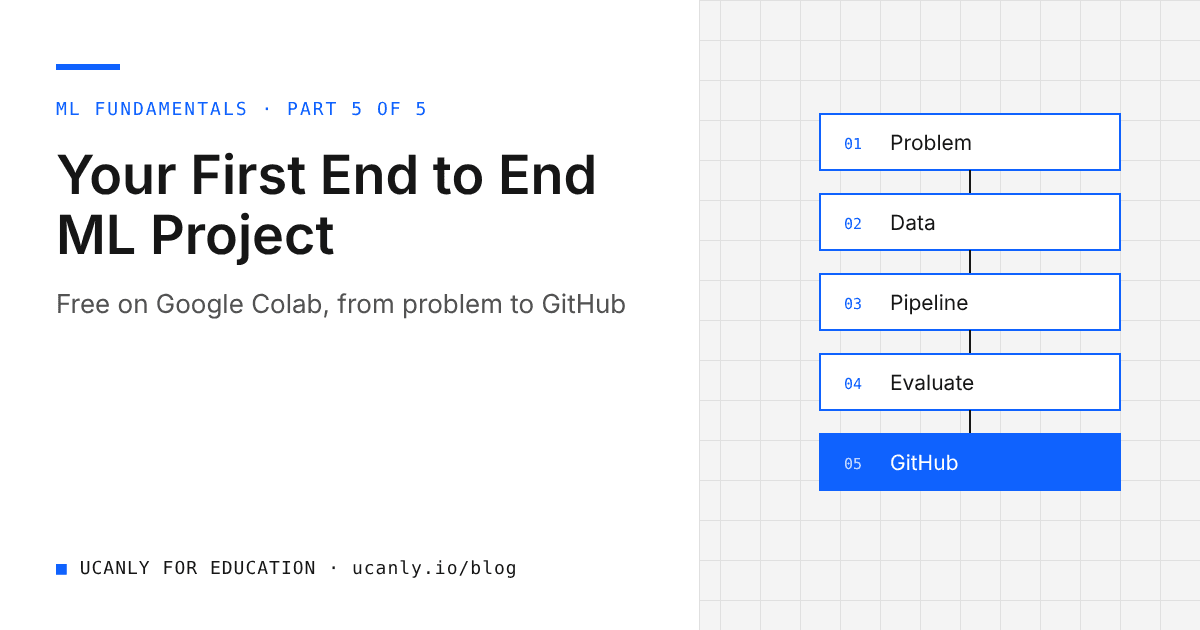
Every serious project follows roughly these steps:
- Define the problem. What exactly are you predicting, and how will the prediction be used?
- Collect data. From college records, public datasets on Kaggle, APIs, or surveys you run yourself.
- Explore the data (EDA). Use pandas to check shapes, missing values, distributions and obvious errors.
- Prepare the data. Handle missing values, convert text categories to numbers, scale numeric columns, and split into training and test sets.
- Choose and train a model. Start with something simple, such as logistic regression for classification or linear regression for regression.
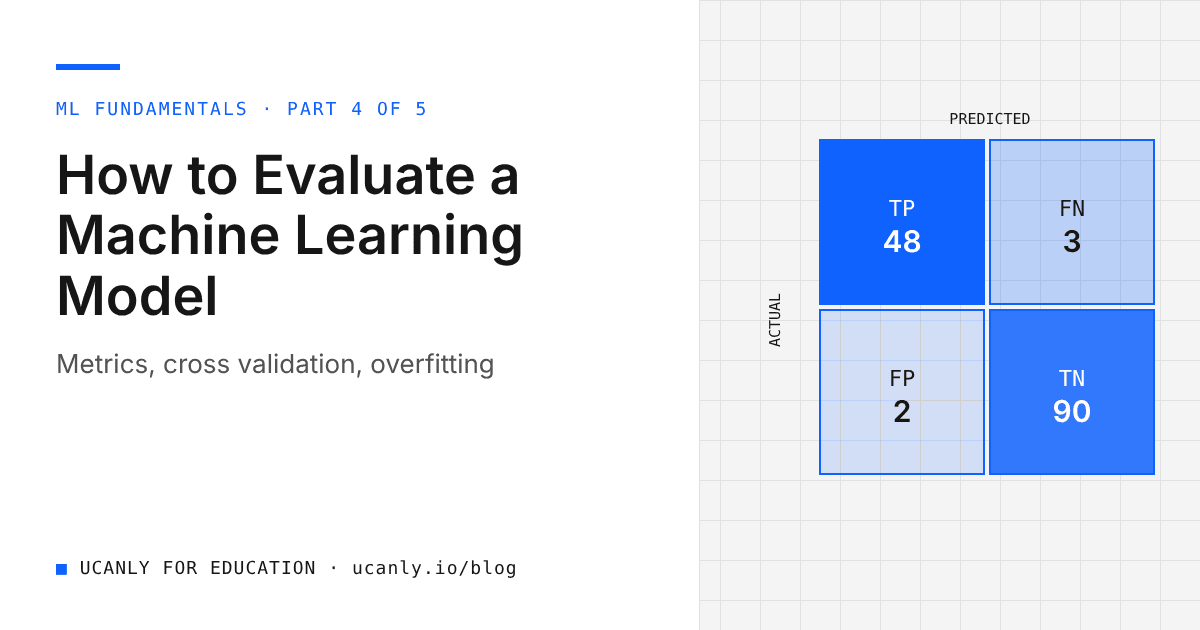
- Evaluate. Measure performance on the test set with suitable metrics: accuracy, precision, recall and F1 for classification; mean absolute error or R squared for regression.
- Improve. Try better features, other algorithms, tuning, or cross validation.
- Deploy and monitor. Wrap the model in a small API or app, and keep checking whether it still performs well as new data arrives.
For a portfolio project, steps 1 to 7 done carefully plus a clean README already sets you apart. If you want guided practice through this workflow, our courses walk through each stage with real datasets.
Your First Model: Iris Classification in Python
The iris dataset has 150 flowers from three species, with four features each: sepal length, sepal width, petal length and petal width. It ships with scikit-learn, so open a Google Colab notebook (or run pip install scikit-learn pandas locally) and start.
Step 1: Look at the data
from sklearn.datasets import load_iris
import pandas as pd

iris = load_iris(as_frame=True)
df = iris.frame
print(df.shape)
print(df.head())
print(df["target"].value_counts())
print(iris.target_names)
You should see 150 rows and 5 columns (four features plus the target), with 50 flowers of each species. The target is stored as 0, 1 and 2, which map to setosa, versicolor and virginica.
Step 2: Split, train, evaluate, predict
from sklearn.datasets import load_iris
from sklearn.model_selection import train_test_split
from sklearn.pipeline import Pipeline
from sklearn.preprocessing import StandardScaler
from sklearn.linear_model import LogisticRegression
from sklearn.metrics import classification_report, confusion_matrix

X, y = load_iris(return_X_y=True)

X_train, X_test, y_train, y_test = train_test_split(
    X, y, test_size=0.2, random_state=42, stratify=y
)

model = Pipeline([
    ("scale", StandardScaler()),
    ("clf", LogisticRegression(max_iter=1000)),
])

model.fit(X_train, y_train)
y_pred = model.predict(X_test)

print(confusion_matrix(y_test, y_pred))
print(classification_report(y_test, y_pred, target_names=load_iris().target_names))

new_flower = [[5.1, 3.5, 1.4, 0.2]]
print(load_iris().target_names[model.predict(new_flower)[0]])
train_test_splitkeeps 20 percent of the data aside as a test set.stratify=ykeeps the species balanced in both parts, andrandom_statemakes the split repeatable.- The
Pipelinefirst scales the features withStandardScaler, then fits aLogisticRegressionclassifier. This ensures scaling is learned only from training data, avoiding data leakage. fitis training.predictis prediction.- The confusion matrix shows which species got mixed up with which. The classification report gives precision, recall and F1 for each class.
When we ran this, test accuracy came out at roughly 93 percent, with setosa classified perfectly and a small mix up between versicolor and virginica. The new flower is predicted as setosa.
Step 3: Get a more honest score with cross validation
One small test set can be lucky. Cross validation averages results over several splits.
from sklearn.datasets import load_iris
from sklearn.model_selection import cross_val_score
from sklearn.pipeline import Pipeline
from sklearn.preprocessing import StandardScaler
from sklearn.linear_model import LogisticRegression

X, y = load_iris(return_X_y=True)
model = Pipeline([
    ("scale", StandardScaler()),
    ("clf", LogisticRegression(max_iter=1000)),
])
scores = cross_val_score(model, X, y, cv=5)
print(scores.round(3), scores.mean().round(3))
In our run the five fold average was around 96 percent. Reporting this instead of a single split makes your project look more mature.
The Maths You Actually Need to Start
You need working comfort with four areas, learned alongside coding.
- Basic statistics: mean, median, variance, standard deviation, distributions, correlation.
- Probability: conditional probability and the idea behind Bayes' theorem. Classifiers like logistic regression output probabilities, so you should know what a probability of 0.8 really means.
- Linear algebra: vectors, matrices, dot products and matrix multiplication. Your dataset is a matrix, each row is a vector, and most models are built from dot products.
- Calculus, lightly: what a derivative and a gradient mean, and the intuition of gradient descent: nudging parameters in the direction that reduces error.
Key takeaway: Learn maths just in time. Intuition you can explain in an interview matters more than solving integrals.
Common Beginner Interview Questions
Practise answering these out loud:
- What is the difference between supervised and unsupervised learning? Give one example of each.
- Is predicting house price classification or regression? Why?
- What are features and labels?
- Why do we split data into training and test sets?
- What is overfitting, and how would you detect it? (Hint: high training score, much lower test score.)
- Why is accuracy not always a good metric? (Think of imbalanced data, such as fraud detection where almost all transactions are genuine.)
- What is cross validation and why use it?
Expect these questions about any ML project on your resume. Run your resume through our AI resume review to check your project descriptions state the problem, data, model and result clearly.
What to Do Next
You now know the core ideas and have trained a real classifier. Next steps:
- Rerun the iris notebook on Colab and change one thing at a time: the test size, the model (try
RandomForestClassifier), or remove scaling. - Repeat the workflow on a new dataset, such as
load_breast_cancerfromscikit-learnfor classification orfetch_california_housingfor regression. - Pick one small, original project connected to your own life, such as hostel mess feedback or club event registrations, with a clear README.
- Strengthen the maths gradually, one topic per week, tied to what you are coding.
- Plan the bigger journey. Sign up for a personalised career roadmap to map out the skills between where you are now and your first data or ML role.
One focused hour a day on real code beats weeks of passive videos.