If you can explain a concept so that a younger student finally gets it, you already have a skill that families and juniors will pay for. Online tutoring and teaching coding is one of the most reliable ways for Indian college students to earn while studying, because it builds on what you are already learning and needs almost no upfront investment. This guide walks you through choosing a niche, running your first demo class, pricing with a clear method, and growing through parent referrals without hurting your grades or placement preparation.
Why Tutoring and Coding Mentorship Pay Better Than Typical Student Jobs
Most part time student jobs pay for your hours. Tutoring pays for your outcomes: a better exam score, a working first program, a cleared coding round. Parents and students value those outcomes highly, so a good tutor can usually charge more per hour than for generic work like data entry or delivery shifts. How much you earn still depends on your skill, your niche and the effort you put into results.
Other reasons it works well:
- Low startup cost. A laptop, a stable internet connection, a free video calling tool and a shared whiteboard are enough.
- Flexible hours. School students study in the evenings and on weekends, which fits around college timetables.
- Compounding reputation. One happy parent in a housing society or school WhatsApp group can bring several new students.
Choose Your Niche and Build the Right Skills
Do not try to teach everything. Choose one or two lanes where you are genuinely strong.
Niche options
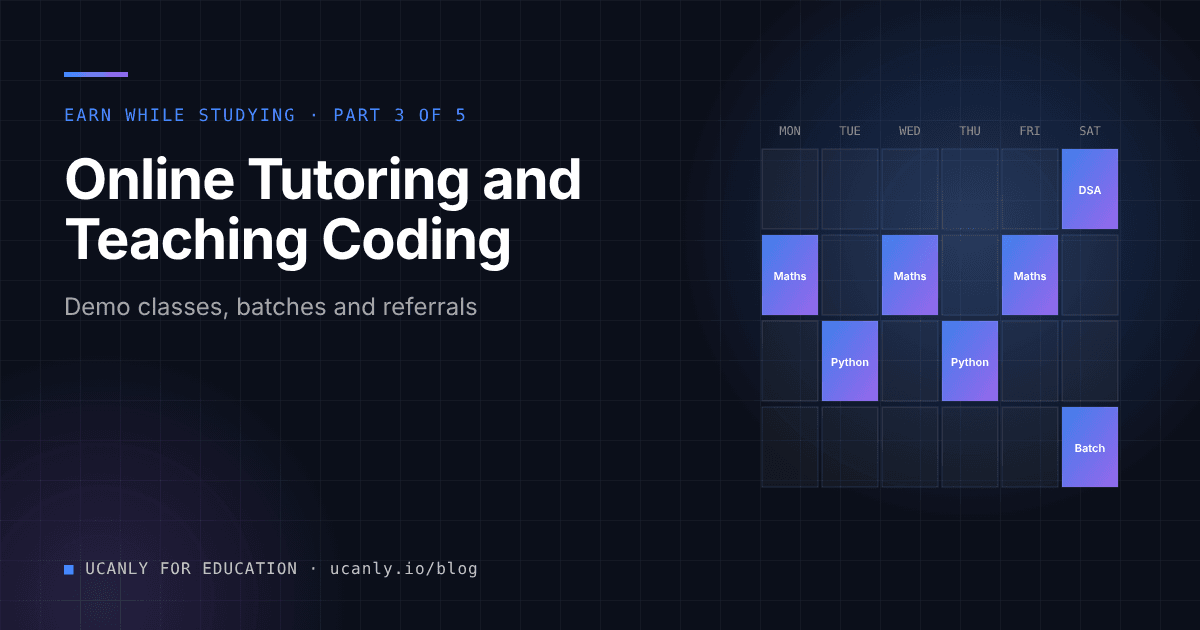
- School maths and science (Class 6 to 12): board exam preparation, concept clearing, homework support. Works well if you scored strongly in these subjects and still remember the syllabus.
- Programming for school students: Python basics, Scratch for younger kids, simple web pages, logic building. Parents increasingly want their children to learn coding early.
- DSA mentoring for college juniors: arrays, recursion, trees, graphs and dynamic programming, plus mock interview practice. Best if you have solved a large number of problems and understand patterns, not just answers.
- Small group batches: three to six students at the same level. Lower price per student, higher earning per hour for you.
- Recorded mini courses: short, focused topics like "Recursion in 7 Days" or "Class 10 Trigonometry Crash Revision", sold to students who prefer self paced learning.
Skills you need
- Strong command of the subject at least two levels above what you teach
- Clear explanation in the language your students prefer, with patience to break problems into small steps
- Basic comfort with tools: video calls, a digital whiteboard, Google Forms for tests, and a simple online code editor
- Reliability: showing up on time, every time
If you want to sharpen your own fundamentals before teaching, structured courses on DSA and programming will help you teach with confidence.
Your 30 Day Start Plan
Days 1 to 7: Foundation
- Pick one niche and one target audience (for example, Class 9 and 10 maths in English medium CBSE schools).
- Write a one page syllabus with weekly topics.
- Prepare three sample lessons with notes and practice questions.
Days 8 to 14: Proof and setup
- Teach two or three free trial sessions to cousins, neighbours or juniors.
- Ask each for written feedback you can share with permission.
- Create a simple profile: a one page PDF or a basic web page with your background, subjects, schedule and contact details.
- Set up a payment record sheet and a class tracker.
Days 15 to 21: Outreach
- Message your network (see the templates below).
- List yourself on two or three tutoring marketplaces and local classified platforms.
- Post in college groups offering DSA doubt sessions for juniors.
Days 22 to 30: Demo classes and conversion
- Run demo classes for every interested lead.
- Convert at least a few into paid students.
Running a Demo Class That Converts
The demo class is where parents decide. Treat it like a short, well planned lesson, not a sales pitch.
Demo class structure (30 to 40 minutes)
- Five minutes: Understand the student. Ask what they find hard, their last test result, and their goal.
- Five minutes: Quick diagnostic. Two or three questions to see where they actually stand.
- Fifteen to twenty minutes: Teach one concept fully. Pick something they struggled with and make them solve one problem on their own by the end.
- Five minutes: Share a plan. Explain what the next four weeks would cover and how you will track progress.
- Five minutes: Talk to the parent. Summarise what you observed, your plan, schedule and fees.
After the demo
Send a short message the same day:
Hello [Parent name], thank you for the demo today.
What I observed: [Student] understands [topic] but loses marks on [specific gap].
Plan for 4 weeks: [Topic 1], [Topic 2], weekly test every Sunday.
Schedule: [Days and time]. Fee: [amount] per [month or session].
Happy to answer any questions. Regards, [Your name]
Finding Students and Setting Your Price
Your own network first
Start with people who already trust you: relatives, family friends, old school teachers and neighbours.
Hi [Name], I am a [year] [branch] student at [college].
I am starting online classes for Class [X] maths and science
and Python for school students. Small batches, weekly tests,
progress updates for parents. First demo class is free.
If you know any family who may need this, please share. Thank you!
For DSA mentoring
Post in your college coding club or juniors' groups:
Starting a 6 week DSA batch for 2nd year students.
Covers arrays to dynamic programming, 3 sessions a week,
weekly mock interview. Limited to 5 students per batch.
Free first session. DM me for details.
Platforms
Use general tutoring marketplaces, local classified sites and professional networking platforms. Read each platform's fees and terms carefully.
Referrals from parents
Parents trust other parents more than any advertisement. To earn referrals:
- Send a short monthly progress note with test scores and what improved.
- After a good result, ask politely: "If you know another family who might benefit, I have a slot open on weekends."
- Offer a small benefit, such as an extra revision session, for successful referrals. Keep it simple and honest.
How to price
Avoid guessing. Use a method.
- Research the local market. Check what other tutors in your city and niche charge on marketplaces and local groups for similar classes and experience.
- Position yourself honestly. As a student tutor you may start at or slightly below the middle of that range, then raise prices as your results and reviews grow.
- Price by format. One on one sessions cost more per student. Group batches cost less per student but earn more per hour overall. Recorded courses are a one time price.
- Price by outcome intensity. Board exam crash courses and interview preparation can command higher fees than routine homework help.
- Charge monthly in advance. It reduces missed sessions and payment follow ups.
Earnings depend on your skill, your niche and the effort you put into teaching and retention.
Proof, Portfolio and Resume Value
Proof checklist
- A one page profile with your subjects, education and teaching approach
- Sample notes or worksheets you created
- One or two short recorded explanation videos
- Written feedback from students or parents, shared with their permission
- Anonymised progress examples (for example, "improved in weekly tests over two months")
- For coding: a GitHub repository with beginner projects your students built, with permission
- For DSA: a curated problem list and your own solved problem record
How tutoring strengthens your resume
Teaching shows communication, ownership and technical depth, which interviewers value. On your resume you can write lines like:
- "Mentored a batch of juniors in DSA over a semester through weekly sessions and mock interviews."
- "Designed and delivered a beginner Python course for school students with hands on projects."
Teaching also gives you strong interview stories about explaining complex ideas simply. Run your updated resume through the AI resume review to make sure these points read clearly and match the roles you apply for on the jobs board.
Staying Safe, Balanced and Compliant
Mistakes and scams to avoid
- Skipping the demo plan. An unstructured demo rarely converts.
- No written schedule or fee terms. Leads to confusion and unpaid sessions.
- Fake tutoring agencies. Be careful with anyone who asks for a registration or "verification" fee before assigning students, or asks for your bank login or OTP.
- Overpayment scams. If someone "accidentally" pays extra and asks for a refund to another account, verify carefully before sending anything.
- Online safety with minors. Keep sessions professional, keep a parent informed or present for younger children, and avoid private chats unrelated to studies.
Balancing with studies and placements
- Cap your teaching hours per week and protect your exam weeks by pausing new admissions.
- Group students into batches at fixed times so you are not scattered across the week.
- Teaching DSA strengthens your own problem solving, but keep separate time for your own practice and contests.
- During placement season, inform parents early and reduce the load or arrange a reliable substitute.
- Use a career roadmap to plan when to scale tutoring up and when to scale it down around internships.
Compliance basics
This is general guidance, not legal or tax advice.
- Keep records of every payment, student name, dates and amounts in a simple spreadsheet.
- Income may be taxable depending on your total income and situation. Consult a qualified tax professional or chartered accountant if your earnings grow.
- Check your college rules on part time work, especially if you hold a scholarship or are on a student visa.
- Respect copyright. Do not sell other people's notes or videos as your own.
What to Do Next
Choose one niche today, write a four week syllabus this week, and teach two free trial sessions to people you know. Then send your outreach message, run structured demo classes, and price using the market research method above. Track every payment, protect your study time, and turn each satisfied parent into a referral. Within a month you can have a small, steady teaching practice that builds your income, your confidence and your resume together.